When you’re spending £15,000 to £40,000 on a smart home system, the credential of the person installing it matters. Loxone certifies its installers in three tiers — Bronze, Silver and Gold — and the difference between them is not cosmetic. It reflects training hours, programming competence and the complexity of installations a partner is qualified to deliver.
This article explains exactly what Silver Partner status means, how it’s earned, and what questions to ask any installer who claims to have it.
The three Loxone partner tiers
Bronze Partner Entry-level certification. Completed basic Loxone Campus training (typically 2–3 days). Qualified to install and commission straightforward residential systems — single-room or simple multi-room lighting and heating control.
Silver Partner Mid-tier certification. Multiple weeks of Loxone Campus training across hardware, programming and commissioning modules. Qualified to specify, install and commission complex residential systems: multi-zone lighting, Multiroom Audio, climate control, access control, security and energy management. Silver Partners have completed a minimum number of certified installations and demonstrated competency on third-party system integrations.
Gold Partner Top-tier certification. Full Loxone curriculum plus commercial systems, advanced programming and multi-Miniserver architectures. Typically held by large residential integrators and commercial contractors.
What does Loxone Campus training actually involve?
Loxone runs its partner training at Loxone Campus in Smart Home Austria (and at UK partner venues). The curriculum for Silver Partners covers:
- Hardware specification — selecting the right Miniserver, extensions and accessories for a given project
- Wiring and installation — Tree topology, cable routing, cabinet build and safety compliance
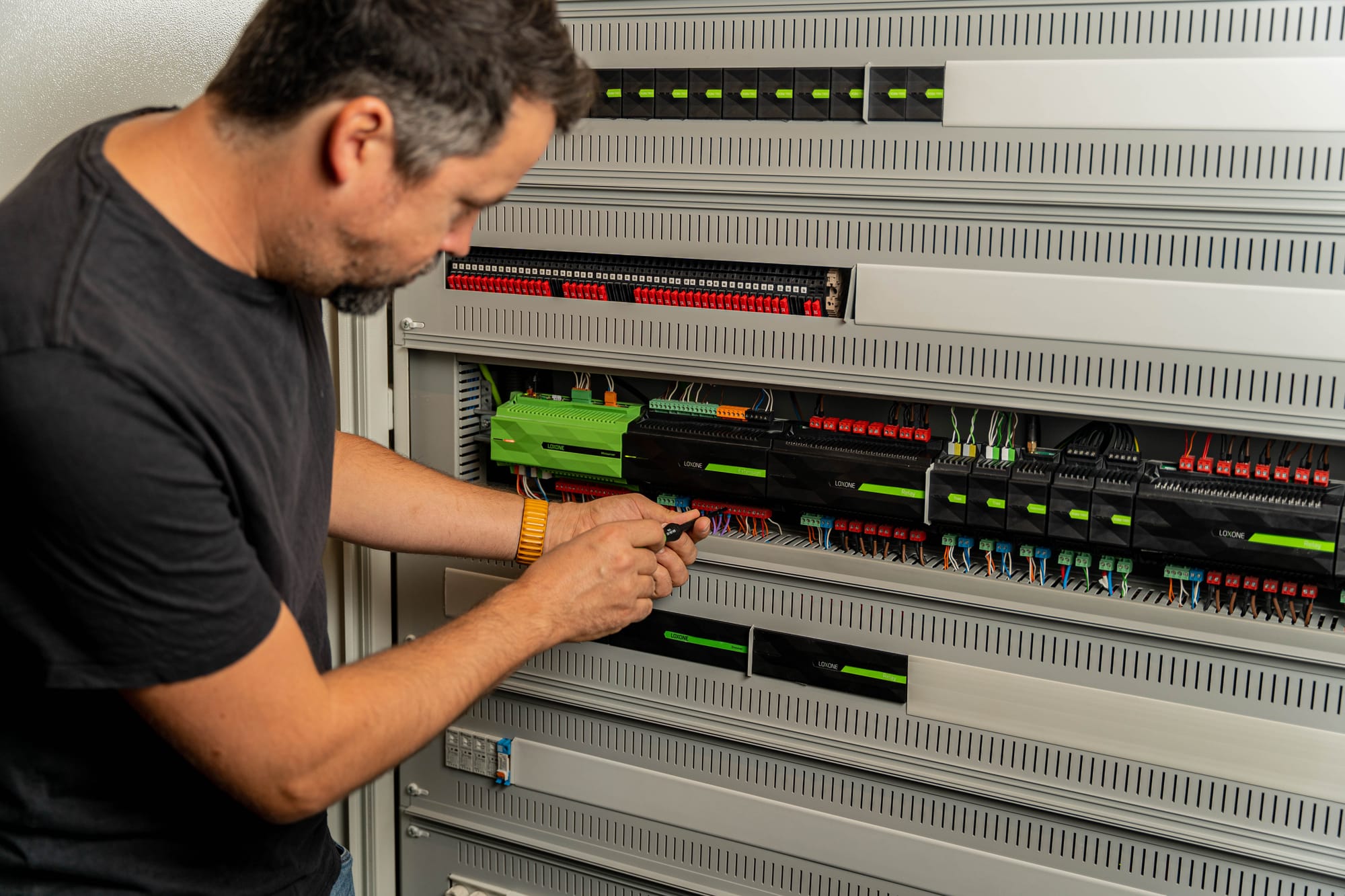
- Loxone Config programming — building the software logic that makes scenes, automations and integrations work. This is the most technical part and the biggest differentiator between certified and uncertified installers.
- Miniserver commissioning — loading and testing the completed configuration, integrating with third-party systems (audio, CCTV, solar)
- Customer handover — demonstrating the system and training the end user
The programming stage is why certification matters most. A generic electrician can install the hardware. Only someone who has completed the programming curriculum can commission a system that actually automates — one that responds to conditions and schedules rather than just responding to app taps.
Why does it matter for your installation?
1. You get a system that actually automates
85% of a Loxone installation is software. The hardware is excellent and relatively straightforward to install. What turns a wired building into a genuinely smart home is the configuration — the logic that makes lights respond to occupancy, heating respond to time-of-day and weather, and security respond to triggers.
An uncertified installer can wire a Loxone system. They cannot commission it properly. The result is a house with Loxone hardware running as a glorified light switch.
2. Your warranty has backing
Loxone’s manufacturer warranty applies to hardware. But the 12-month parts-and-labour warranty a certified partner provides covers both hardware failure and programming issues. Non-certified installers often can’t provide this coverage because they’re not accountable to Loxone’s quality standards.
3. You can escalate to Loxone directly
Certified partners have a direct support line to Loxone’s technical team. If your installation has an issue that requires Loxone’s involvement, a certified partner can escalate it. An uncertified installer cannot.
4. The installer is accountable
Loxone can revoke partner certifications for poor practice. This creates a meaningful accountability mechanism that doesn’t exist with a generic smart-home installer who claims to “support Loxone.”
How to verify a Loxone partner’s certification
- Ask for their partner tier — Bronze, Silver or Gold. A genuine partner knows their tier immediately.
- Check the Loxone partner finder — Loxone’s website lists certified partners by postcode. If they don’t appear there, they’re not certified.
- Ask how many Loxone-trained engineers they have — at Westgate, all four engineers are Loxone-trained. Some “Silver Partners” have one trained person and sub-contract the rest.
- Ask for examples of past installations — a Silver Partner should be able to show you comparable completed projects.
Westgate Property Solutions: Loxone Silver Partner, East Midlands
Westgate is a Loxone Silver Partner based in Mansfield Woodhouse (NG19), covering Nottinghamshire, Derbyshire, South Yorkshire and Lincolnshire. All four engineers are Loxone-trained. We do not sub-contract installations.
Our Silver Partner status means we can specify, install and commission the full range of residential Loxone systems: from a single-room garden-room package to a whole-house multi-Miniserver installation on a large self-build.
Book a free site visit or see our Loxone packages to understand what a certified installation looks like in practice.
The bottom line
When a Loxone Silver Partner installs your system, you get:
- Engineers trained on Loxone hardware and programming
- A system that automates, not just remote-controls
- A 12-month parts-and-labour warranty with certified backing
- Direct Loxone technical support when needed
- A partner accountable to Loxone’s quality standards
When an uncertified installer quotes half the price, ask what they’re leaving out. The answer is usually: the programming, the commissioning, the warranty accountability and the support line that exists when something goes wrong.
Jack Jones
Director, Westgate Property Solutions · Loxone Silver Partner